
What does OSHA require for portable toilets on a construction site?
The rule is 1926.51(c)(1), and it scales with headcount. Up to 20 workers, you need 1 toilet. From 20 workers up to 200, add 1 toilet seat and 1 urinal for every 40 people. Past 200 workers, that ratio loosens to 1 seat and 1 urinal per 50. It sounds simple until a crew swings between 18 and 35 people over a project, which happens constantly on construction site services around Grand Forks. Anyone researching osha portable toilet requirements construction rules for the first time should start with headcount, not unit count. Plan for your peak headcount, not your average day. OSHA also requires an adequate supply of potable water at every place of employment under 1926.51(a)(1), which matters when you are speccing units for a site that has no water hookup yet. If you are not sure how the math works for your crew size, the how many porta potties do i need guide walks through it step by step, and our standard porta potty rental page has unit specs if you want to check tank size against expected use.
How many porta potties do I need under OSHA rules?
Count your largest single shift, not your total roster, then apply 1926.51(c)(1). A 25-person framing crew in Grand Forks needs at least 1 toilet seat and 1 urinal beyond the base unit, because 25 workers crosses the 20-worker threshold. Add a second full toilet if your site sanitation standard, ANSI/PSAI Z4.3, calls for weekly service on units seeing more than 10 users across a 40 hour week, since heavier use means shorter intervals between pumps regardless of the OSHA minimum. Distance from the work area counts too, and osha portable toilet distance requirements come up often on spread-out sites. OSHA does not publish a hard toilet distance number in 1926.51, but placement still has to keep units reachable without workers losing time walking. If your crew is spread across a large lot, look at the porta potty placement guide before delivery day. For agricultural crews doing hand labor, a separate standard, 1928.110, sets facilities at one per 20 employees within a quarter mile walk, which is worth knowing if your operation sits closer to Thompson, 12.5 miles south, than to downtown Grand Forks.
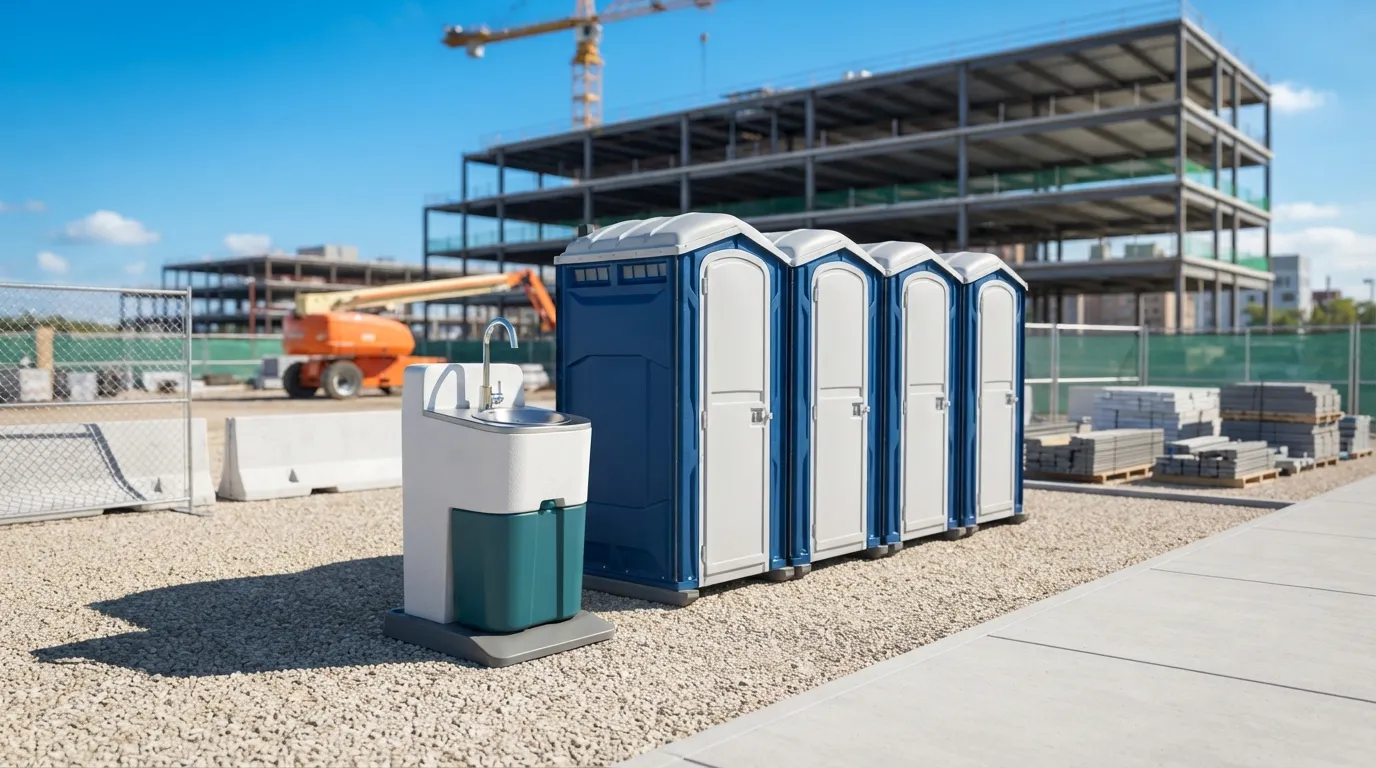
Are ADA accessible units required on job sites?
Yes, once you cluster units. ADA Standards section 213.2 requires at least 5 percent of clustered single-user portable toilets to be accessible, and never fewer than one unit even if your math rounds down to zero. That accessible unit needs a 60 inch turning circle under section 304.3.1, a 36 inch clear route per 403.5.1, and a door opening at least 32 inches wide under 404.2.3. Crews searching for portable toilet rental oshawa style compliance guidance elsewhere will find the same ADA math applies here in Grand Forks, since these are federal standards, not local ones. Floor surfaces have to be stable and slip resistant under 302.1, and hardware has to operate one-handed with 5 pounds of force or less under 309.4. Most job sites in Grand Forks satisfy this with one ADA accessible porta potty added to a bank of standard units rather than converting every stall. If your project also serves the public, not just crew, check the ADA restroom requirements page, because event and spectator access can trigger a different ratio than a construction crew alone. Note that Cal OSHA sets its own state-level portable toilet requirements for California job sites, separate from the federal standard covered here, so if you run crews in both states do not assume the ratios match.
Does OSHA require handwashing stations too?
Sometimes, and it depends on the work. 1926.51(f)(1) requires washing facilities specifically where employees are applying paints, coatings, herbicides or insecticides, or working around similar contaminants. It is not a blanket handwashing mandate for every job site. Separately, 29 CFR 1910.141(d)(2) requires soap and towels or a hand-drying device at washing stations. Hand sanitizer alone does not satisfy that rule. If your crew is painting, coating, or spraying chemicals in Grand Forks, pair your toilets with a handwashing station rental rather than relying on sanitizer stands. GFCI protection under 1926.404(b)(1)(ii) and general site housekeeping under 1926.25 are worth a look too if you are building out a full compliance checklist, and the handwashing requirements page covers the difference between the paint-and-coatings trigger and general sanitation. For sites also handling debris removal, a roll-off dumpster rental or a construction dumpster rental keeps you square with waste disposal rules under 1926.252 at the same time. Sites juggling tools and materials alongside sanitation gear often add a storage container rental too, the same way a crew researching storage container rental oshawa would pair the two rentals for a single job.
Standard units in the region run in this range, useful for budgeting a compliant unit count before delivery:
| unit | duration | typical price |
|---|---|---|
| standard | day | $150 |
| standard | week | $200 |
| standard | month | $200 |
For full pricing detail across event and weekend rates, see porta potty rental cost or monthly porta potty rental. Crews near East Grand Forks, 4.7 miles east, or Emerado, 14.2 miles west, fall under the same federal ratios, since OSHA rules do not change by city.
How many workers can share one porta potty under OSHA?
Up to 20 workers can share a single toilet under 1926.51(c)(1). Past 20, you add 1 seat and 1 urinal per 40 workers, and that ratio shifts to 1 per 50 once headcount hits 200 or more.
Does OSHA set a maximum distance from work to the toilet?
1926.51 does not publish a specific distance figure. The agricultural standard, 1928.110, does set a quarter mile walking limit for hand-labor field crews, which is the closest published distance rule in the fact set here.
Do I need an ADA unit for a small crew?
Yes, if you are clustering units. ADA Standards 213.2 requires at least one accessible unit regardless of total count, even when 5 percent of your total would round down to zero.
Is hand sanitizer enough to meet handwashing rules?
No. 29 CFR 1910.141(d)(2) requires soap and towels or a hand-drying device at washing stations. Sanitizer does not replace that requirement where it applies.
Does a small renovation job need to follow these same ratios?
Yes, the ratio under 1926.51(c)(1) applies regardless of project size. Even a short home renovation porta potty job with a handful of workers needs at least one compliant toilet on site.
Next step
Get a delivery date
Tell us the address, the dates and the headcount. We size the order and confirm the route.